
Follow Us

Hybrid Event Production for Financial Services
Years before hybrid events became common, a leading Canadian financial services organization wanted to bring live and virtual audiences together in the same program.
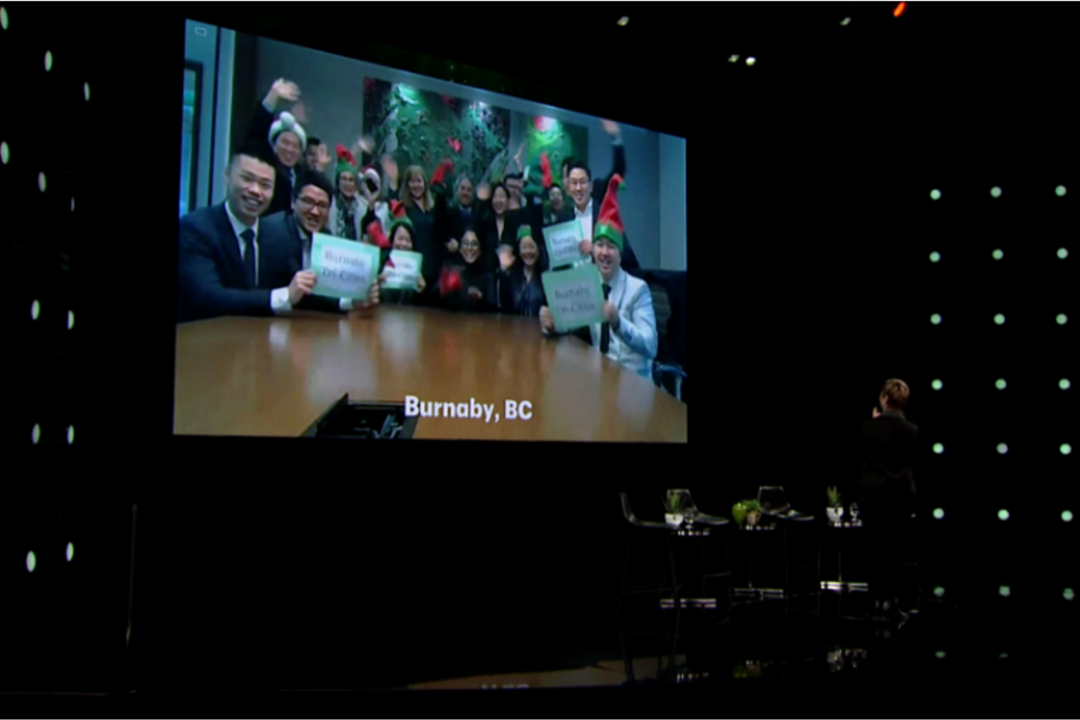
The request was simple to ask and much harder to produce: create an event that worked for hundreds of people in the room, while also keeping more than 1,000 attendees across Canada engaged from a distance.
ELP shaped the program through a broadcast lens, rethinking how content, production, and audience participation could work across both formats. What started as an early hybrid event became a repeatable approach that continued to evolve over the years.
The client needed more than a livestream of a live meeting.
The goal was to create one event experience for two very different audiences: the people attending in person and the colleagues joining remotely across the country. Both groups needed to feel included, informed, and connected to the same program.
At the time, hybrid event production was still an emerging idea. The work required technical planning, creative thinking, and a willingness to rethink how a corporate meeting could be produced.
The challenge was not just getting the technology to work. It was designing the event around two audience experiences at the same time.
A live audience can read the room, respond to the speakers, and follow the energy in the space. A virtual audience needs a different kind of attention: strong pacing, clear visuals, camera direction, and content that holds up on a screen.
For this program, the event had to work both ways. It needed the excitement of a live corporate gathering and the structure of a produced broadcast.
ELP approached the program less like a standard meeting and more like a live broadcast with an audience in the room.
That meant looking closely at content flow, speaker delivery, visual support, timing, production cues, and how remote attendees would follow and participate. ELP also drew from broadcast and television production thinking to help shape the format.
The result was not a live event with a camera pointed at the stage. It was a hybrid model planned around the room, the remote audience, and the way the content needed to come across on screen.
The first program gave the client a format they could keep building on.
Over time, the event continued to evolve. Teams tested new approaches to content, graphics, set design, audience engagement, and production structure. Each year made the format stronger and easier to apply to future programs.
That early work became especially valuable years later, when virtual and hybrid events became a regular part of corporate communication.
The program brought together hundreds of in-person attendees in Toronto, with more than 1,000 people joining virtually across Canada.
Beyond the first event, it gave the client a repeatable model for connecting a distributed corporate audience. The format continued to inform future virtual and hybrid programming.
For ELP, the success was not only that the event worked. It was that the model held up over time and gave the client a practical way to connect people across locations.
- Hybrid event strategy
- Broadcast-style production planning
- Live and remote audience planning
- Content structure and show flow
- Technical planning and production coordination
- Speaker flow and presentation support
- Production timing and cueing
- Year-over-year format development
What is a hybrid corporate event?
A hybrid corporate event is designed for both in-person and virtual audiences. A good hybrid event is not just a livestream. It is planned so both audiences can follow the content and feel part of the same program.
How do you make a hybrid event engaging for virtual attendees?
Virtual attendees need more than access to a video feed. Engagement depends on strong pacing, clear content, polished production, visual variety, and moments designed with the remote audience in mind.
What makes hybrid event production more complex than a standard live event?
Hybrid event production has to account for two audience experiences at the same time. The room needs to feel live and connected, while the remote audience needs a clear, well-produced experience that works on screen.
Can ELP produce hybrid events for financial services organizations?
Yes. ELP produces hybrid, virtual, broadcast, leadership, and internal communication events for financial services audiences.
- Mary Kay Cosmetics Canada
- Canadian Breast Cancer Research Alliance Conference Case Study
- A Global Consumer Electronics Brand Pop-Up Concert Launch in Toronto
- Virtual Dealer Product Launch for an Automotive Brand
- Krispy Kreme Canadian Store Opening Events
- Virtual Incentive Event for a Financial Services Organization